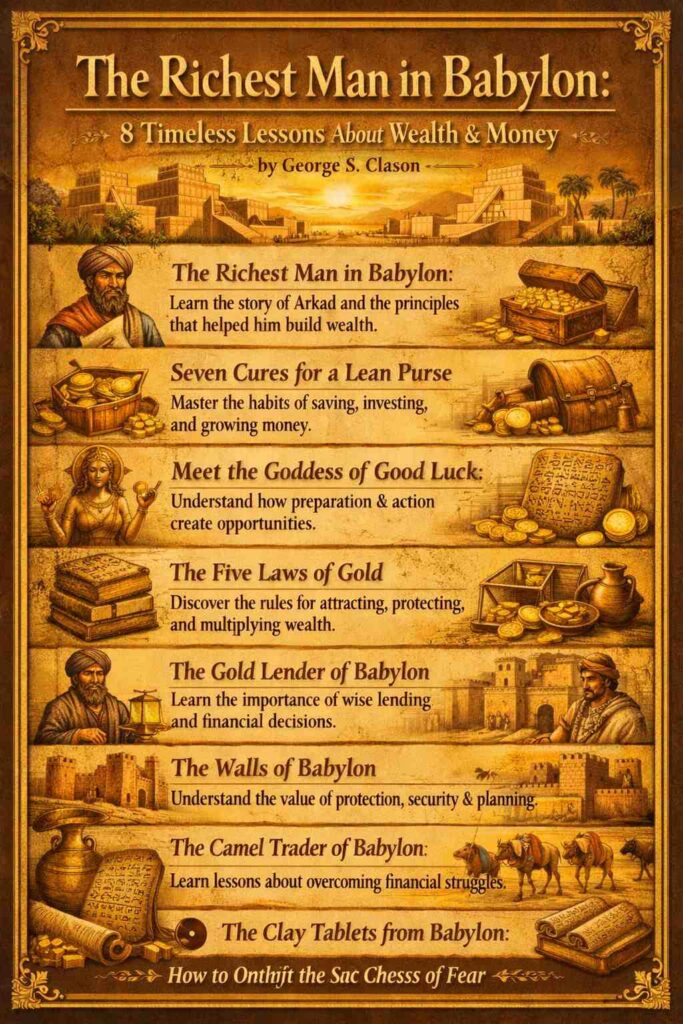
This Richest Man in Babylon summary covers the key lessons shared by George S. Clason. Through a series of stories set in ancient Babylon, the author teaches important principles about saving money, investing wisely, managing debt, and building wealth. These timeless lessons provide practical guidance for achieving financial success and creating a secure future.
LESSON – 1
The Richest Man in Babylon
CONTEXT STORY
In The Richest Man in Babylon summary, Arkad is introduced as the richest man in Babylon. His friends, who grew up with him and were once just like him, were surprised by his success and asked how he became so wealthy. In response, Arkad explained that he had always had a strong desire to accumulate wealth. He also shared how he met Algamish, the richest man of that time, and the Three valuable lessons he learned from him, which guided him toward financial success.
THREE VALUABLE LESSONS
1. Pay yourself first
Just like you pay others for their services, you should also pay yourself. Set aside at least one-tenth of your earnings as savings. At first, the amount may seem small, but over time it grows. The main challenge is resisting the temptation to spend it, so discipline is important.
2. Seek advice from knowledgeable people
Always take guidance from those who are experienced in the relevant field. Just as you would not ask a baker about stars, you should consult the right experts for financial decisions. Good advice helps you invest wisely and avoid losses.
3. Reinvest your earnings
Money earned from investments should not be spent immediately on luxuries. Instead, reinvest it to build more wealth. You can spend freely only when your income becomes large enough that your expenses do not affect your financial stability.
LESSON – 2
Seven Cures for a Lean Purses
CONTEXT STORY
In Babylon, after King Sargon completed a large construction project, many workers lost their jobs and many citizens struggled financially. The king wanted every citizen to live a better life, so he asked Arkad, the richest man in Babylon, to teach the secret of building wealth. Arkad gathered One Hundred students and taught them the “Seven Cures for a Lean Purse.”
1. The First Cure
The first cure is Save at least 10% of your income and live on 90%. Many people may find this difficult, but if spending is managed wisely, it is possible. In The Richest Man in Babylon summary, Arkad saved one coin out of every ten he earned. He realized that he could still meet his needs with the remaining nine coins when he spent carefully.
2. The Second Cure
The second cure is Increasing income alone is not enough if spending also increases. Arkad explains that as income rises, desires also increase, which leads people to spend more. To control this, he advises making a budget. List your needs and wants clearly and focus on essential spending.
3. The third cure
The third cure is Invest your money. Saving is important, but money does not grow if it is kept idle. It must be invested to increase wealth. Arkad explains the power of compound growth through the story of a farmer who invested 10 pieces of silver for his son. After fifty years, it grew to 167 pieces. This is one of the key lessons in The Richest Man in Babylon summary about making money work for you.
4. The fourth cure
The fourth cure is Avoid quick-money schemes and untrusted investments. Many people are tempted by high returns and invest without proper knowledge or trust the wrong people, which leads to loss. In The Richest Man in Babylon summary, Arkad shares how he trusted a brickmaker, Azmur, to buy jewels for him even though he had no experience. The Phoenicians sold him glass instead of jewels, and the investment failed. The lesson is to seek advice from knowledgeable people before investing.
5. The fifth cure
The fifth cure is Own a home. In The Richest Man in Babylon summary, Arkad suggests that a person should own a home if it can be done without harming basic needs. A home provides shelter, comfort, stability, and a better environment for the family to grow.
6. The sixth cure
The sixth cure is Prepare for old age. Life naturally moves from youth to old age, and a person must prepare for the time when they can no longer work. Arkad advises that once a person earns a surplus, they should invest part of it for the future instead of spending everything in the present.
7. The seventh cure
The seventh cure is Improve yourself. Arkad explains that a person must have a strong inner desire, not just a wish like “I want to be rich.” One must set clear goals and work consistently toward them. As skills, focus, and knowledge improve, earning ability also increases.
LESSON – 3
Meet The Goddess of Good Luck
In this story of The Richest man in Babylon summary, the discussion is about luck. Arkad and some men talk about good luck, and some suggest that it can be found at gambling tables or horse races. However, Arkad quickly explains that these are unreliable and are usually designed so that the organizer wins in the long run. While some people may win occasionally, gambling is not a dependable source of wealth, and no one becomes truly successful through it.
The discussion then moves to a deeper idea shown through different stories: real “luck” comes from recognizing opportunity and acting on it. I can relate this to a personal experience. About 15 years ago, there was an opportunity to buy land at a low price. The area had strong future potential, with a bus park planned and several road projects underway. However, the decision was delayed, and now the land price has increased four to five times. Those who acted early benefited greatly.
This reflects a key lesson in The Richest Man in Babylon summary: What people often call luck is usually the result of preparation meeting opportunity, followed by decisive action.
LESSON – 4
The Five Laws of Gold
CONTEXT STORY
In this story of The Richest Man in Babylon summary, Nomasis is given two things by his father:
- a bag of gold
- clay tablets containing the “Five Laws of Gold”
However, there is a condition. He must leave home and live independently for ten years, managing the money on his own. Only after that will he be allowed to inherit his father’s wealth.
During this period, Nomasis loses all his gold through horse betting, trusting the wrong people, and making poor investment decisions. He eventually becomes broke and realizes that the real value was not the gold, but the wisdom written on the clay tablets. After that, he studies the tablets carefully and learns the “Five Laws of Gold,” which guide him toward better financial understanding.
By the end, Nomasis recovered all his wealth with the help of those 5 laws.
1. First Law
Save at least 10 percent of your earnings. If you consistently set aside a portion of what you earn, wealth will slowly build over time.
2. Second Law
Money should not sit idle. It must be invested in order to grow and generate more income.
3. Third Law
Seek advice before investing. Always consult experts in the relevant field before making investment decisions. This helps reduce mistakes and financial loss.
4. Fourth Law
Be careful with attractive opportunities. Many opportunities look appealing at first but may be risky. Do not invest in things you do not understand. Always do proper analysis before committing money.
5. Fifth Law
Avoid quick-profit schemes and emotional decisions. Chasing fast returns or making decisions based on emotion often leads to loss instead of wealth.
LESSON – 5
The Gold Lender of Babylon
CONTEXT STORY
In the story, The Richest Man in Baylon summary, Rodan was a skilled spear maker. He received fifty pieces of gold from the king as a reward for designing a better spearhead. Soon after, his relatives and friends begin asking him for financial help. His sister wanted him to lend the money to her husband so he can become a merchant. Unsure of what to do, Rodan seeks advice from Mathon who was a successful gold lender. Rather than giving a simple yes or no answer, Mathon shares stories from his experience as a lender and gives us key lessons.
KEY LESSONS:
1. Protect Your Wealth First
Money represents years of hard work and sacrifice. Before lending or investing it, make sure it is protected. Losing your savings through poor decisions can erase years of effort.
2. Lend Only to Those Who Can Repay
According to The Richest Man in Babylon summary, A borrower’s honesty is not enough. They should also have the income or assets to repay the loan. Wise lenders focus on repayment, not promises. Mathon shows that he only lends to people with property, income, or trusted guarantees, like the farmer who repays after his crops succeed.
3. Do Not Let Emotions Control Financial Decisions
Helping family and friends is important, but financial decisions should be based on reason. Emotional decisions often lead to financial loss. Just like in the story, Mathon friend borrowed money from him to fulfill all the desires from his wife which ended badly, and he couldn’t get his money back.
4. Borrow for Productive Purposes
According to The Richest Man in Babylon summary, Loans should be used to create income or grow a business, not to satisfy temporary desires. Productive borrowing increases the chances of success and repayment. The farmer borrows gold to buy goats, which later increase his income and allow repayment.
5. Experience Matters More Than Ambition
Dreams alone do not guarantee success. Before investing or borrowing, a person should have the knowledge and experience needed to achieve their goal. Rodan sister’s husband Araman wants to become a merchant but has no knowledge of buying or selling goods, so Mathon considers it unsafe.
6. Avoid Get-Rich-Quick Opportunities
Be cautious of investments that promise unusually high returns. Sustainable wealth is built through patience, careful planning, and wise decisions. In the story, The young trader loses money after poor decisions, leaving his father’s land as security.
LESSON – 6
The Walls of Babylon
CONTEXT STORY
In the story of Richest Man in Babylon summary, there was a huge battle where enemy armies try to break into the ancient city of Babylon. The city is under attack, and the soldiers on the walls are fighting hard to stop them. Inside the city, regular people are terrified and were not sure if they will survive if the enemy breaks through.
A soldier named Banzar stands near the gate. People keep coming to him asking the same question again and again saying “Are we safe? Will the walls hold?”. Each time they asked, he reassures them and give them hope by saying “The walls are strong and the city is protected”.
After many days of fighting, the enemies were defeated and The city survives because its strong defense.
KEY LESSON:
LACK OF PROPER PROTECTION CANNOT BE AFFORDED
Just like Babylon had strong walls for security, an individual must have a wall for themselves for security in the form of life insurance, health plans, saving account and proper investments. This is the key lesson from Richest Man in Babylon summary.
LESSON – 7
The Camel Trader of Babylon
In the story of Richest man in Babylon summary, many years earlier there was a guy named Dabasir who was an ordinary saddle maker. Although he earned enough to support himself, he wanted a better lifestyle than he could afford. He started buying expensive clothes, household items, and other luxuries using borrowed money. Eventually his debts became larger than his income.
Soon, creditors began asking for repayment. Unable to face them, Dabasir chose to run away from Babylon, believing a fresh start somewhere else would solve his problems. Instead, his situation became much worse. After struggling to make a living, he joined a group of desert robbers. Their luck did not last long. They were captured, and Dabasir was sold as a slave in Syria.
While serving his new master, Dabasir met Sira, one of the master’s wives. She noticed that although he claimed to be a free man, his actions told a different story. She asked him a question that stayed in his mind. The question was “Do you have the soul of a free man or the soul of a slave?”. Sira explained that a free person accepts responsibility for their actions, while a slave keeps making excuses and allows circumstances to control their life. Her words deeply affected Dabasir.
Not long afterward, Sira secretly gave him a chance to escape. She provided him with camels, supplies, and directions toward Babylon. The journey across the desert was brutal. Day after day, Dabasir struggled through scorching heat with very little food or water. Eventually, exhausted and close to death, he collapsed in the desert. Lying there alone, he thought about the choices that had brought him to this point. For the first time, he realized that his greatest mistake was not borrowing money. It was running away from the responsibility of repaying it.
In that moment, everything changed. He promised himself that if he survived, he would return to Babylon, meet every person he owed, repay every debt, rebuild his reputation, and become a man worthy of respect again.
That decision gave him a new sense of purpose. He found the strength to continue his journey and eventually made it back to Babylon.
When Dabasir returned home, he visited each creditor, admitted his mistakes, and promised to repay them little by little. Some people doubted him, while others encouraged him. A money lender named Mathon helped him find work with a respected camel trader, where Dabasir’s experience with camels allowed him to earn a steady income.
Over time, he fulfilled every promise. Every debt was repaid. His reputation was restored, and he became one of Babylon’s most respected camel traders.
THE KEY LESSON IS “WHERE THE DETERMINATION IS, THE WAY CAN BE FOUND”.
LESSON – 8
The Clay Tablets from Babylon
Tablet I
In Richest Man in Babylon summary, A man named Dabasir returns from slavery with one goal. That is to rebuild his life and clear his debts. He gets advice from a money lender named Mathon, who teaches him a simple rule for handling money.
The rule has three parts:
- Save 10% of everything you earn for yourself.
- Spend 70% on living expenses like food, home, and family.
- Use 20% to slowly repay debts.
The key idea is simple control. Don’t spend everything you earn.
Tablet II
He writes down all the people he owes money to. Instead of avoiding debt, he faces it directly.Many people avoid looking at their financial problems because they feel embarrassed. Dabasir chooses honesty instead. This is one of the biggest turning points in the story.
Tablet III
He explains how he got into trouble in the first place. He ran away from his problems and even lost his wife for a time. That made things worse. Now he goes back to his creditors and tells them his plan. He cannot pay everything at once, but he will pay slowly and consistently. Some people get angry, but most agree. The lesson is that steady repayment is better than avoiding debt completely.
Tablet IV
He starts earning again by working and trading camels. Even when money is low, he sticks to the same system: Save 10%, Live on 70% and Pay debt with 20%. Over time, he notices progress. Debt reduces, and he even starts keeping some money for himself. Therefore consistency is important. Small disciplined actions beat occasional big actions.
Tablet V
After many months, he finally pays off all his debts. His relationships improve, people respect him, and he gains confidence.
You Can Also learn The Following Summary: