The Mastery written by Robert Greene provides six principles that shows how people can discover their true purpose and achieve excellence in their chosen field. It emphasizes understanding your natural interests, avoiding distractions from social pressure, and developing skills through focused practice and experience over time.
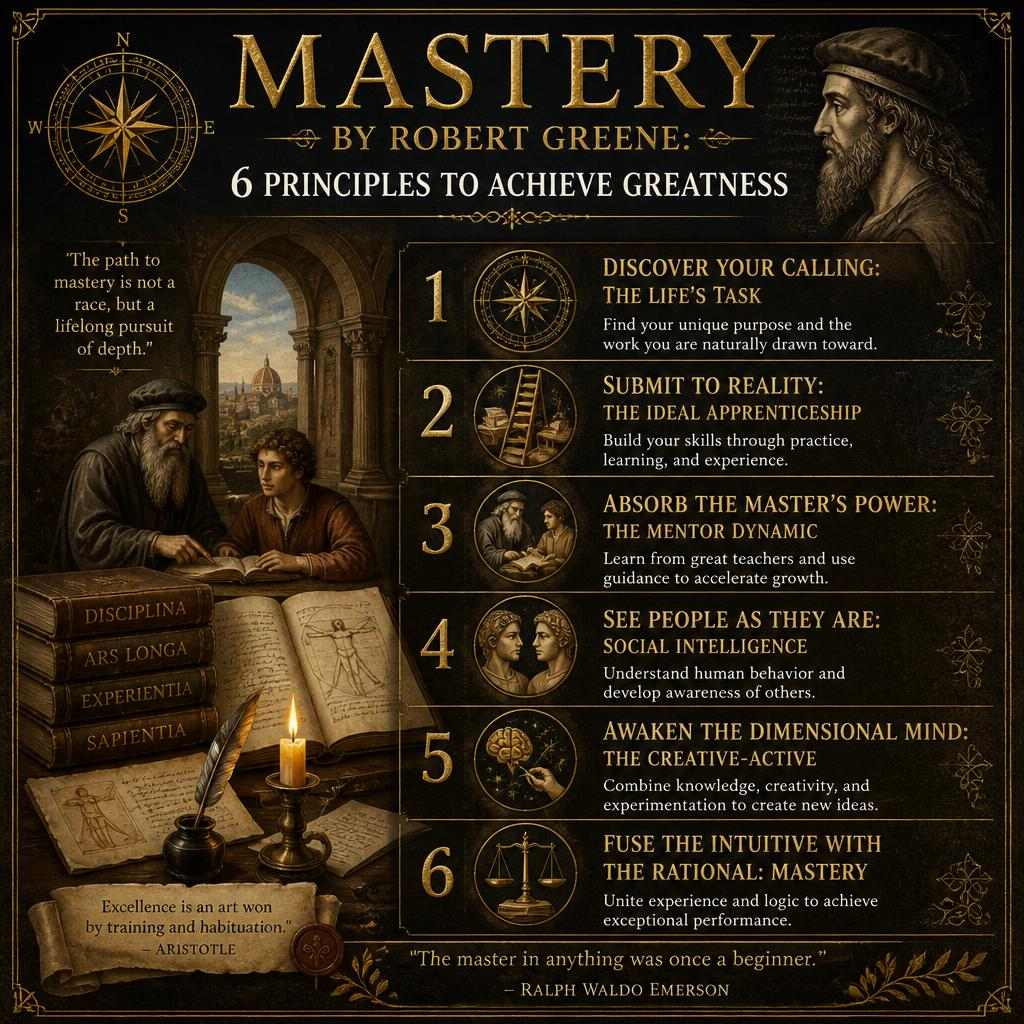
CHAPTER – 1
Discover Your Calling: The Life’s Task
DESCRIPTION
According to Mastery summary, many people are unique in nature, with their own interests, abilities, and capabilities. The main purpose of a person should be to develop their skills and abilities in line with their goals and strive to become the best at what they do. However, this is often not possible due to several reasons. Parents may not agree with certain career choices, considering them risky and preferring safer options. Friends and social circles may also influence decisions, as people often try to fit in. Social pressure from society can also play a role.
This becomes dangerous because if a person’s interest does not match their work, motivation starts to fade. Work becomes stressful and boring, and there is little desire to improve or grow. Over time, this leads to a lack of direction.
Five strategies for finding one’s life task
1. Do what you love
The best way to discover what you truly enjoy is to reflect on your childhood or earlier interests, before outside influences shaped your choices. Often, there are activities that naturally excited you. For example, a friend who loved cooking would constantly read recipe books and experiment with new dishes.
2. Avoid excessive competition by finding a niche
The professional world is highly competitive, and entering a crowded field can drain your energy and reduce your chances of mastery. Instead, it is better to find a specific niche that suits your strengths. For that Start broad. Begin with a wide field of interest and gradually narrow it down. For example, dietetics is a broad field. You can refine it further by specializing in areas like sports nutrition. After mastering your primary field, you can combine it with another skill learned in your free time. For instance, if you also learn writing, you can combine it with sports nutrition and write a book on the subject.
3. Avoid choosing a career based only on money or fame
Many people select careers because they are attracted to money, fame, or attention. In the Mastery summary, while these factors may create initial motivation, they usually fade over time. When that happens, interest is lost and the work starts feeling stressful and unfulfilling.
4. Adapt to change and keep learning
Change is inevitable. Our environment, technology, and ways of thinking constantly evolve. The mastery summary emphasizes that instead of holding on to old methods or living in the past, you should adapt your skills, keep learning, and view change as an opportunity for growth rather than a setback.
5. Follow your true path despite challenges
Moving away from your natural path can create a sense of emptiness or dissatisfaction, which is often a sign that something is not right. The mastery summary emphasizes that you should pay attention to this feeling and choose a direction that suits you. This process is not easy and requires sacrifices, patience, and persistence. There will be many challenges along the way, and running away from them will only lead to regret. In the end, if you stay patient and keep moving forward without avoiding difficulties, you will succeed.
CHAPTER – 2
Submit To Reality: The Ideal Apprenticeship
DESCRIPTION
Every master, no matter what field they were in spent atleast 5 to 10 years learning before becoming successful. That period is called apprenticeship phase. During that time they were not special but were building skills that will make them successful.
According to mastery summary, author says that main purpose of apprenticeship is to learn, improve yourself and build skills. During that time, you should focus on gaining experience, learn from mistake, accept feedback and become disciplined. Author also suggests that instead of choosing easiest job, choose opportunities where you can learn the most even though it may be difficult. The knowledge and experience you gain will help you succeed.
The Apprenticeship Phase: The Three Steps
1. Deep Observation (The Passive Mode)
When you start a new job, career, or skill, your first goal should be to watch, listen, and learn. Many beginners make the mistake of trying to impress everyone right away. Instead of doing that observe carefully and focus on learning. Pay attention to successful people and notice what they do differently. Also learn from the mistakes of others so you can avoid making the same ones.
2. Skills Acquisition (The Practice Mode)
After observing and learning, the next step is consistent practice. In Mastery summary, the author explains that reading helps, but real improvement comes from doing the work yourself. Focus on mastering one important skill before moving to others, since trying to learn everything at once can slow your progress.
Although practice may feel difficult at first, each session strengthens your brain and makes the skill more natural. According to the mastery summary, the author says that achieving mastery often requires about 10,000 hours of focused practice, usually over 7 to 10 years, making patience and consistency essential.
3. Experimentation (The Active Mode)
After observing and practicing, the final step is to put your skills into action. Take on bigger responsibilities, start projects, and welcome feedback to discover your strengths and areas for improvement.
Mastery summary says to not fear criticism or mistakes because real growth happens when you challenge yourself. Once you have learned all you can from your current environment, move on to new opportunities and continue learning.
Eight Strategies for Completing Ideal Apprenticeship
1. Value Learning Over Money
When you’re just starting, don’t worry too much about making a lot of money. Choose opportunities where you can learn new skills and gain experience. A job or internship with a good teacher or mentor is often more valuable than one with a bigger paycheck. The skills you build now will help you earn much more money in the future.
2. Keep Expanding Your Horizons
Never stop learning new things. Don’t only study what your school or job requires. Read books, watch educational videos, learn new skills, and talk to different kinds of people. Every new thing you learn helps you understand the world better and gives you more opportunities later in life.
3. Revert to a Feeling of Inferiority
When you start learning something new, don’t pretend you already know everything. Be humble and accept that others may know more than you. Ask questions, listen carefully, and be willing to learn. Just like young children learn quickly because they are curious, you will also learn faster if you keep an open mind.
4. Trust the Process
Learning a new skill is difficult at first, and that’s completely normal. You might feel frustrated or think you’re not improving. But if you keep practicing regularly, your brain slowly gets better at the skill. Over time, things that once seemed impossible will start to feel easy. Success comes from being patient and not giving up.
5. Move Toward Resistance and Pain
The best way to improve is to practice the things you find hardest. Most people only practice what they are already good at because it feels easier. Instead, spend more time working on your weaknesses. It may feel uncomfortable, but that’s where real learning happens. Every challenge you overcome makes you stronger and more skilled.
6. Apprentice Yourself in Failure
Don’t be afraid to make mistakes. Every failure teaches you something important that success cannot. If you try something and it doesn’t work, think about what went wrong and improve your next attempt. The people who become successful are usually the ones who fail many times but keep learning and trying again.
7. Combine the “How” and the “What”
Don’t just learn what something is. Try to understand how it works. For example, don’t only learn how to use a computer. Learn how it works inside. Don’t just watch a successful YouTuber. Learn how they make videos, attract viewers, and earn money. Understanding how things work gives you deeper knowledge and helps you solve problems better.
8. Advance Through Trial and Error
When you’re young, it’s okay if you don’t know exactly what you want to do in life. Try different hobbies, projects, and skills that interest you. Some things will suit you, and some won’t. Every experience teaches you something useful. As you grow, you’ll discover what you’re good at and combine all the skills you’ve learned into something unique.
CHAPTER – 3
Absorb The Master’s Power: The Mentor Dynamic
DESCRIPTION
If you want to become really good at something, having a mentor is one of the fastest ways to learn. Books and videos are useful, but they cannot give advice based on your specific situation. Learning only through trial and error can take many years. A mentor gives feedback, points out your mistakes, and teaches you what really matters.
According to the mastery summary, to find a mentor, you should first build some basic skills and show that you are hardworking, reliable, and willing to help. Most successful people are busy, so they are more likely to teach someone who brings value and has a positive attitude.
However, mentors are not perfect. Some will encourage you to become independent, while others may try to keep you working for them. Your goal is to learn as much as you can and, when the time is right, move on without feeling guilty.
Four Strategies For Deepening the Mentor Dynamic
1. Choose the right mentor
In mastery summary, pick a mentor who matches your goals and personality, not just someone who is famous or successful. A good mentor should help you become the best version of yourself, not a copy of them.
2. Accept honest feedback
According to mastery summary, A good mentor will tell you the truth about your mistakes and weaknesses, even if it is hard to hear. Instead of avoiding criticism, use it to improve. Honest feedback helps you grow faster and build real confidence based on your skills.
3. Make the ideas your own
Learn everything you can from your mentor, but don’t copy them forever. As you gain experience, change and improve their ideas to fit your own style. The goal is to develop your own way of thinking and eventually become even better than your mentor.
4. Build a two-way relationship
As you become more skilled, don’t just listen. Share your own ideas and experiences with your mentor while still respecting them. When both of you learn from each other, the relationship becomes stronger and helps both people grow.
CHAPTER – 4
See People as they are: Social Intelligence
DESCRIPTION
When we are kids, we often see our parents as perfect superheroes because we depend on them. Later, we realize they also make mistakes, and we may become too negative about them. In mastery summary, the author calls this the Naïve Perspective which means seeing people based on our feelings instead of reality.
The mastery summary also talks about social intelligence. It means learning to understand people better.It has two parts:
1)Specific Knowledge: Reading People
Pay attention to body language, emotions, actions, and patterns instead of only words.For example, someone may say they are confident, but their nervous behavior and constant need for approval may show insecurity.
2)General Knowledge: The Seven Deadly Realities of Human Nature
It refers to recognizing common weaknesses in people:
- Envy: People may dislike others’ success.
- Conformity: Groups pressure people to follow the majority.
- Rigidity: People resist change.
- Self-obsession: People often think about their own interests first.
- Laziness: Some seek shortcuts instead of hard work.
- Flightiness: People’s emotions can change their decisions.
- Passive aggression: Some people express anger indirectly.
Four Strategies for Acquiring Social Intelligence
1. Let your work speak for you
Mastery summary says that instead of telling everyone how good you are, show it through your actions. If you do your homework well, help your teammates, and put effort into your work, people will notice.
2. Create the right image of yourself
People judge you by how you behave. You should learn how to act properly in different situations. This does not mean pretending to be someone else. It means showing the best version of yourself. For example, You can be funny with your friends but respectful and serious when talking to a teacher.
3. See yourself from other people’s eyes
Sometimes we notice other people’s mistakes but ignore our own. To improve, you need to understand how others experience you.
Ask yourself:
Am I being a good listener?
Do I hurt people with my words?
Do I get angry too quickly?
Knowing your weaknesses helps you become a better person.
4. Don’t let foolish people disturb you
You will meet people who create drama, want attention, or make bad decisions. Getting angry and fighting with them only wastes your energy. Stay calm, focus on your goals, and learn from their mistakes. For example, if someone tries to annoy you in class, instead of arguing, ignore them and focus on your studies.
CHAPTER – 5
Awaken The Dimensional Mind: The Creative-Active
DESCRIPTION
As children, we are naturally curious, imaginative, and excited to learn. This is called the Original Mind. As we grow up, we often stop questioning things and follow habits and rules. This is the Conventional Mind. Masters stay creative because they keep their childhood curiosity while also gaining years of knowledge and practice. This combination is called the Dimensional Mind.
According to mastery summary, unlocking Dimensional Mind requires three steps:
- Choose the right task
This means you should work on something that fits your interests and abilities. If you enjoy what you do, you will have more energy to learn, practice, and improve. For example, if you love drawing, you should spend time improving your art skills instead of forcing yourself into something you hate. - Open your mind
This means don’t always think in the same old way. Be curious, ask questions, and try different methods. For example, if everyone solves a problem one way, try to find another way that might work better. - Create the right mindset
Good ideas need time. You need to focus, think deeply, and give your brain space to create new connections. Don’t rush. Many great ideas come after spending a lot of time learning and thinking about a problem.
Seven Strategies for Reaching the Creative-Active Phase
The creative-active phase is the stage where a person becomes capable of creating original ideas instead of only following existing methods.
1. The Authentic Voice
Develop your own style by first mastering the basics of your field. True originality comes after deep learning and practice. For example, A musician first learns traditional music techniques, then combines them with personal experiences to create a unique sound.
2. The Fact of Great Yield
Look for small, unusual observations or problems that can lead to important discoveries. Stay curious and explore widely.
3. Natural Powers
Give your mind freedom and time to create. Experiment, learn from different fields, and do not rush the process.
4. The Open Field
Find gaps in existing systems and create something new instead of simply following trends.
5. The High End
Focus on the bigger purpose of your work instead of getting trapped in small details and techniques. Experts sometimes become too focused on techniques and procedures. They follow the same methods repeatedly and forget the original purpose of their work. For example, a businessperson may focus only on profits and forget about solving customer problems.
6. The Evolutionary Hijack
Be flexible and look for new uses of existing ideas. Creativity often comes from seeing things differently.
7. Alchemical Creativity
Combine different ideas, subjects, and perspectives to create something original and innovative. Many people think in opposites: Science vs art, Logic vs emotion, old vs new. Creative thinkers combine these different areas.
For example, combining technology and psychology can create better products. Combining art and engineering can create innovative designs.
CHAPTER – 6
Fuse The Intuitive with The Rational: Mastery
DESCRIPTION
Masters develop high-level intuition through years of focused practice, experience, and learning. Their brains become skilled at recognizing patterns and understanding complex situations quickly. This ability is not magic but the result of deep knowledge, reflection, and continuous improvement. In Mastery summary, Author explains that true masters combine intuition with logic, allowing them to see the bigger picture and make better decisions. Mastery comes from patience, discipline, and deeply understanding the connections within a field
Five Strategies for Attaining Mastery
1. Connect to your environment: Primal Powers
Pay attention and notice things other people miss. Most people go through life without really observing. Masters watch carefully and learn from everything around them.
2. Play to your strengths: Supreme Focus
Know what you are naturally good at and improve it. Many people try to copy others. But everyone has different strengths.
3. Transform yourself through practice: The Fingertip Feel
Practice until your skill becomes natural. When you start something new, it feels difficult.
For Example, When you first learn to ride a bicycle You think about balance., You think about pedals, You worry about falling. After enough practice Your body automatically knows what to do. This happens with every skill.
4. Submit to the other: The Inside-Out Perspective
Try to understand other people’s point of view. Most people think “How would I feel?” but Masters think “How does this person feel?”
For Example, if your friend is angry, a normal reaction is “Why are they acting weird?”, A better reaction is “Maybe something happened that I don’t know about.”
5. Synthesize all forms of knowledge: The Universal Man/Woman
Learn many things and connect them. Great thinkers do not only know one subject. They combine different ideas. For Example, A person who knows Technology, Psychology, Design can create better apps because they understand both computers and people.
You Can Also learn The Following Summary: