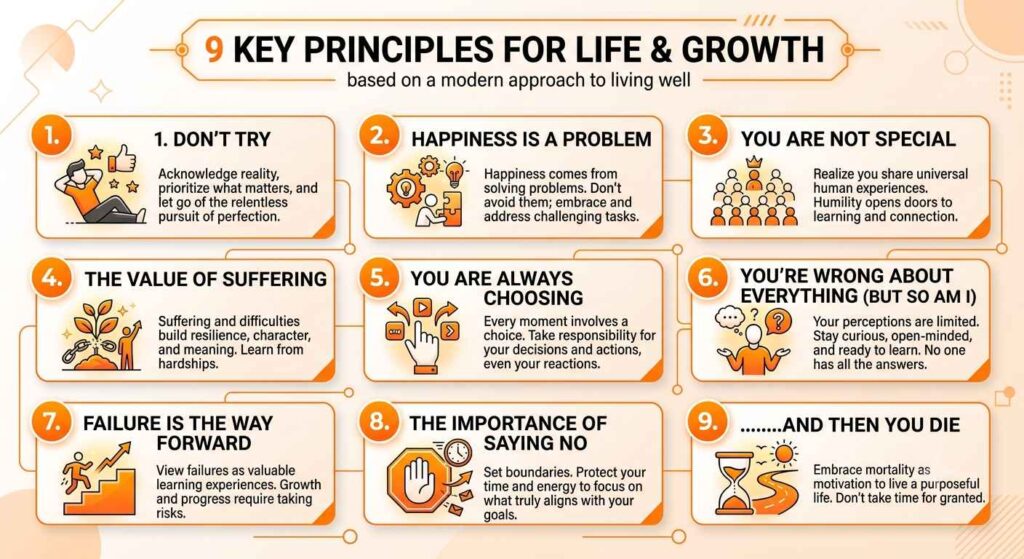
The Subtle Art of Not Giving a F*ck summary explains the powerful lessons shared by Mark Manson about living a happier and more meaningful life. The Subtle Art of Not Giving a F*ck summary focuses on always being positive, this book teaches that problems are a natural part of life and the key is choosing what truly deserves your attention. Through honest stories, practical advice, and thought-provoking ideas, Mark Manson explains how accepting struggles, taking responsibility, and focusing on what really matters can help you build a better life.
CHAPTER – 1
Don’t Try
The Feedback Loop from Hell
In The Subtle Art of Not Giving a F*ck summary, Mark Manson talks about something called the Feedback Loop from Hell. This happens when you have a bad feeling and then start worrying about having that feeling.
For example, you have to give a presentation at school. You feel nervous, which is completely normal. But then you start thinking “Why am I so nervous? Am I bad at speaking? What if everyone laughs at me?”. Now you are not only nervous about the presentation, but you are also stressed about being nervous. Your thoughts make the original problem feel even bigger.
The Subtle Art of Not Giving a F*ck summary also explains the Backward Law. It means that sometimes the harder we chase something, the harder it becomes to get. For example, someone who constantly thinks, “I need to become successful to be happy,” may always feel unsuccessful because they are focused on what they have not achieved yet.
The Feedback Loop from Hell is made worse by modern society and social media. We constantly see other people’s achievements, happiness, and success, which can make us feel like our own lives are not good enough. However, people usually share only the best moments of their lives, not their struggles.
The Subtle Art of Not Giving a F*ck
In The Subtle Art of Not Giving a F*ck summary, Mark Manson explains that the idea of not giving a f*ck does not mean becoming careless, emotionless, or indifferent. Instead, it means learning to choose what truly deserves your time, energy, and attention. A meaningful life is not created by avoiding problems but by choosing the right problems to solve.
The first lesson from The Subtle Art of Not Giving a F*ck summary is that not caring does not mean being indifferent. Many people pretend not to care because they are actually afraid of judgment, failure, or rejection. True confidence comes from accepting that you cannot please everyone and being comfortable with being different. A person who follows their values does not waste energy worrying about every opinion or criticism.
The second lesson is that you can only ignore adversity when you have something more important to care about. Problems are a natural part of life, and everyone faces struggles. The goal is not to create a problem-free life but to find meaningful goals that make those struggles worthwhile. When you have a purpose, small frustrations and unnecessary worries lose their importance.
The third lesson is that you are always choosing what to care about. Everyone gives attention and energy to something. As we grow older, we learn that many things we once worried about do not matter in the long term. Maturity means becoming selective about where we invest our energy and focusing on things that truly matter, such as relationships, personal growth, values, and meaningful goals.
CHAPTER – 2
Happiness Is a Problem
The Misadventures of Disappointment Panda
Disappointment Panda is a fictional superhero who delivers uncomfortable truths that people often avoid hearing. His message is that life’s unpleasant experiences are not always bad. Pain, failure, and disappointment serve an important purpose because they help us learn, adapt, and grow.
The chapter from The Subtle Art of Not Giving a F*ck summary explains that suffering is a natural part of being human. Just as physical pain warns us about danger, emotional pain teaches us valuable lessons about relationships, choices, and personal growth. Failure and rejection can show us where we need to improve and prevent us from repeating the same mistakes.
The author argues that problems are a permanent part of life. Everyone has struggles, whether they are rich or poor. The goal is not to create a life without problems, because that is impossible. Instead, we should seek meaningful problems that challenge us and help us become better. For example, Exercising regularly can be uncomfortable, but it makes you healthier and stronger.
Happiness Comes from Solving Problems
The Author explains that happiness is not something we discover after achieving perfect success, wealth, or comfort. It is created through action, growth, and the process of overcoming challenges. People feel fulfilled when they work toward goals they care about and develop the ability to handle difficulties.
Many people become unhappy because they avoid their problems in two ways:
- Denial
Some people refuse to accept that problems exist. They distract themselves instead of facing reality. While denial may provide temporary comfort, ignoring problems often creates more stress and emotional difficulties in the future.
Accepting problems is the first step toward solving them. - Victim Mentality
Some people believe they have no control over their situation. They blame other people, society, or external circumstances for their struggles. Although blaming others can feel relieving for a short time, it prevents personal growth. Taking responsibility gives people the power to make changes and improve their lives.
Many people search for quick ways to feel better instead of solving the real issues in their lives. These distractions may include unhealthy habits, constant entertainment, or chasing temporary excitement. However, avoiding problems only delays them. The longer we ignore important challenges, the more difficult they become to handle. Real happiness comes from facing problems, learning from them, and developing the strength to overcome them.
Emotions Are Overrated
In The Subtle Art of Not Giving a F*ck summary, the author explains that emotions should guide us, but they should not control every decision we make. Just because something feels good does not always mean it is good for us, and just because something feels bad does not always mean it is harmful.
Some people ignore their emotions, while others let emotions decide everything. Both approaches can create problems. The best approach is to understand our feelings and use both emotions and logic when making choices.
The idea of the hedonic treadmill explains why happiness does not last forever. We may feel excited after getting something new, like a toy, phone, or achievement, but after some time it becomes normal, and we want something else.
Life is naturally a combination of pleasure and struggle. The relationship that brings love can also bring conflicts. The dream job that brings success can also bring stress. The house that gives comfort also requires maintenance. Everything valuable comes with challenges.
The important lesson from The Subtle Art of Not Giving a F*ck summary is that happiness is not about eliminating all problems or reaching a permanent state of satisfaction. Problems are a natural part of life. Instead of chasing endless positive emotions, we should learn to understand our emotions, solve meaningful problems, and accept that both joy and difficulty are part of the human experience.
Choose Your Struggle
Everyone wants a happy life, money, success, and great relationships. But the real question is: “What challenges are you willing to face to get what you want?”
Every good thing in life comes with struggles. A strong body needs exercise, success needs hard work, and good relationships need patience and effort. You cannot only want the reward without accepting the difficult journey.
The key lesson from The Subtle Art of Not Giving a F*ck is that your struggles define you. Choose problems that are worth solving and challenges that help you grow. For example, if you want to become a great athlete, you must accept training and discipline. If you want to become successful, you must accept learning, failure, and hard work.
Happiness does not come from having a problem-free life. Problems are a natural part of life, and solving meaningful problems creates growth and fulfillment. Instead of asking, “How can I avoid suffering?” ask, “Which challenges are worth struggling for?”
CHAPTER – 3
You Are Not Special
Things Fall Apart
In The Subtle Art of Not Giving a F*ck summary, Mark Manson shares a true story from when he was 13 years old. His school searched his backpack because they suspected he had drugs. At first, they found nothing, but then they discovered a hidden compartment with marijuana. He was expelled from school, arrested, lost his friends, and later his parents divorced.
These painful events made him feel different from everyone else. He looked for constant approval from others, especially in relationships, and became selfish and unhappy. Later, he realized that treating his problems as unique and impossible to overcome was keeping him trapped in the same mindset.
His biggest lesson is that everyone has problems. Thinking your pain is unique or worse than everyone else’s creates entitlement, whether you believe you’re better than everyone or worse than everyone. Real growth begins when you accept that your struggles are part of being human and take responsibility for improving your life.
The Tyranny of Exceptionalism
Most people are average at most things, and that’s completely normal. Becoming truly great at one skill takes years of focus, so it’s unrealistic to expect excellence in every area of life.
The internet and social media mostly show the most extreme examples like the richest people, the most successful athletes, because we constantly see these, we start believing that being extraordinary is normal. This creates insecurity. We compare our ordinary lives to other people’s best moments and feel like we’re not good enough. As a result, some people chase fame, money, and attention just to feel important.
In The Subtle Art of Not Giving a F*ck summary, the author argues that modern technology has not only made information easier to access but has also increased self-doubt, and unrealistic expectations. The solution is to accept that being average in most areas of life is normal and that real happiness comes from meaningful goals, not from trying to be exceptional all the time.
B-b-b-but, If I’m Not Going to Be Special or extraordinary, What’s the Point?
Being extraordinary sounds exciting, but the author argues that trying to be special all the time can actually make people unhappy. Today, society often tells us that everyone is meant to become famous, rich, or incredibly successful. This creates pressure and make many people feel like failures if they have an ordinary life.
The author explains that truly successful people do not become great because they think they are special. Instead, they know they still have a lot to learn, so they keep practicing and improving. Accepting that you are average in many areas is not giving up. It is a healthy way to grow without constantly comparing yourself to others.
The Subtle art of not giving a F*ck summary teaches that a meaningful life does not depend on being famous or changing the world. Most people’s lives are made up of simple moments like spending time with friends, helping others, learning new things, reading books, and enjoying hobbies. These ordinary experiences may not seem exciting, but they are what bring real happiness and purpose. When you stop worrying about being extraordinary, you can focus on becoming a better version of yourself and appreciate the things that truly matter.
CHAPTER – 4
The Value of Suffering
The Self-Awareness Onion
In The Subtle Art of Not Giving a F*ck summary, Mark Manson explains that self-awareness is like peeling an onion. Each layer helps you understand yourself more deeply.
- The first layer is recognizing your emotions, such as knowing when you feel happy, sad, angry, or nervous. Many people struggle with this because they ignore or hide their feelings.
- The second layer is asking why you feel those emotions. This helps you find the real reason behind your reactions instead of blaming other people or situations.
- The third layer is understanding your values, which are the beliefs and standards you use to judge success, failure, and yourself.
The author explains that unhealthy values can make you unhappy even when your life is going well. He shares an example about feeling hurt because his brother rarely replied to his messages. After asking himself “why” several times, he realized he was judging their relationship by how often they talked instead of the trust and respect they had for each other.
The main lesson In The Subtle Art of Not Giving a Fck summary, is that you cannot always change your problems, but you can change how you understand and measure them. Choosing better values leads to better decisions, healthier emotions, and a happier life.
Rock Star Problems
Success is not only about money, fame, or being better than others. It depends on the values and standards you use to judge your own life. Two people can experience the same situation but feel completely different because they measure success in different ways.
A good example from The Subtle Art of Not Giving a F*ck summary is about Dave Mustaine, the guitarist who was removed from the famous heavy metal band Metallica. After being kicked out, he felt hurt and angry. He used that pain as motivation and created his own band, Megadeth, which became extremely successful. However, even after selling millions of albums and becoming a famous musician, Mustaine still felt like a failure because he compared himself with Metallica, which became even more successful.
His problem was not a lack of achievement. His problem was the way he measured success. He believed he needed to be more famous than Metallica to feel successful. Since he could not reach that goal, he continued feeling disappointed despite his huge accomplishments.
The lesson from these stories is that your values decide how you see success and failure. If you measure your life by comparing yourself with others, you may always feel behind. There will always be someone richer, more talented, or more famous. But if you measure success by personal growth, meaningful relationships, and doing things that matter to you, you are more likely to feel satisfied.
Shitty Values
These are common values that can create problems in The Subtle Art of Not Giving a F*ck summary:
- Pleasure
Pleasure, like eating your favorite food, playing games, or watching movies, is enjoyable. But if your life is only about feeling good all the time, it can become harmful. People who constantly chase pleasure often avoid responsibilities and struggle with anxiety, depression, or addiction. Real happiness comes from achieving meaningful goals, not from endless entertainment.
- Material Success
Money is important because it helps meet basic needs like food, shelter, and healthcare. However, once those needs are met, earning more money or buying expensive things does not make people much happier. If you judge your worth by your salary, car, or lifestyle, you may ignore more important values like honesty, kindness, and healthy relationships. - Always Needing to Be Right
Nobody is right all the time. Everyone makes mistakes, misunderstands things, and has biases. If you believe you must always be correct, you will avoid admitting mistakes and stop learning. Accepting that you don’t know everything keeps you open to new ideas, helps you grow, and allows you to understand other people better. - Stay Positive All the Time
Being optimistic is helpful, but pretending everything is fine when it isn’t can be unhealthy. Life includes disappointment, failure, sadness, and anger. Ignoring these emotions does not solve problems. Instead, it makes them last longer. Healthy people accept negative emotions, express them respectfully, and use them as motivation to improve their situation.
Defining Good and Bad Values
According to the author In The Subtle Art of Not Giving a F*ck summary, good values are based on reality, help create positive relationships, and are things we can control. Bad values are based on unrealistic ideas, can harm ourselves or others, and depend on things outside our control.
Good values include honesty, creativity, curiosity, humility, self-respect, kindness, and standing up for yourself and others. These values are powerful because they come from within. For example, honesty is a good value because you can choose to be honest regardless of what other people do. You do not need anyone’s approval to practice honesty. Similarly, creativity and curiosity depend on your own effort and mindset, making them values you can develop every day.
On the other hand, bad values often depend on external things like fame, popularity, money, or constant approval from others. For example, if your main goal is to be liked by everyone, your happiness will depend on other people’s opinions, which you cannot control. Trying to always be the center of attention, becoming rich only for status, or needing constant pleasure can create stress and disappointment because these goals never fully satisfy you.
The difference between good and bad values is that good values focus on personal growth, while bad values focus too much on external rewards. A person who values creativity can feel successful by creating something meaningful. But a person who values only popularity may feel unhappy if others do not give them enough attention.
CHAPTER – 5
You Are Always Choosing
The Choice
The Subtle Art of Not Giving a F*ck summary gives story of William James who faced many challenges in life. He was born into a wealthy family, but he suffered from serious health problems, struggled in school, and often felt like a failure. While his siblings became successful, James felt lost and unsure about his future.
His father pushed him to study medicine at Harvard, but James felt that medicine was not right for him. He eventually left medical school and joined an expedition to the Amazon. However, his health problems returned, and he came back home feeling defeated and hopeless.
At his lowest point, William James made an important choice. He decided to spend one year believing that he was responsible for his own life. Instead of blaming his problems, he focused on what he could control and tried to improve his situation. This decision changed everything. William James later became known as the father of American psychology. He became a famous writer, professor, and one of the most influential thinkers of his time.
The lesson from William James’s story is simple. We cannot control everything that happens to us, but we can control how we respond. Our choices, attitudes, and actions shape our lives.
The Responsibility/Fault Fallacy
Many people confuse fault and responsibility, but they are different. Something can happen to you that is not your fault, but you are still responsible for how you handle it. For example, someone may hurt you, but you cannot control their actions. You can only control your own choices, emotions, and response. Blaming others keeps you stuck, while taking responsibility helps you grow.
The Subtle Art of Not Giving a F*ck summary, states fault is about what happened in the past, but responsibility is about what you choose to do now. When you accept responsibility for your problems, you gain the power to solve them and improve your life. Taking responsibility does not mean blaming yourself for everything. It means focusing on what you can control and becoming better from your experiences.
Responding to Tragedy
When something terrible happens, people often reject the idea of responsibility because it feels unfair. But responsibility does not mean you caused the event. It means you are responsible for how you respond afterward. For example, if someone is robbed, they are not at fault for the crime. But they still have choices: whether to seek help, recover emotionally, report it, or let the experience control their life. The event may not be their choice, but their response is.
According to The Subtle Art of Not Giving a F*ck summary, this idea also applies to personal tragedies. A person who loses a loved one does not choose that pain, and it is not their fault. However, they still have responsibility for how they process that pain and what they choose to do with it.
Life will always bring situations we cannot control. We cannot choose every event that happens to us, but we can choose our attitude, actions, and the meaning we give to those experiences.
Genetics and the Hand We’re Dealt
Some people are born with challenges they never asked for. They may have genetic conditions, mental health struggles, physical disadvantages, or difficult life circumstances. These things are not their fault, but they still have the responsibility to decide how they respond.
The Subtle Art of Not Giving a F*ck summary provides the story of teenagers with Obsessive-Compulsive Disorder (OCD). Their brains created unwanted fears and compulsive behaviors. Through therapy, they learned that they could not control every thought or feeling, but they could control their actions and choices. Instead of letting OCD control their lives, they focused on bigger values. One wanted freedom from fear, another wanted a normal social life, and another wanted to enjoy life outside his home. By choosing these values and facing their fears, they slowly improved.
This shows that our problems do not define us. We may not choose our genetics, our past, or the difficulties we experience, but we can choose how we deal with them.
Life is like a game of poker. Everyone receives different cards. Some people get better opportunities, while others face harder challenges. But winning is not only about the cards we receive. It depends on the decisions we make with those cards.
Victimhood Chic
Victimhood is when people constantly see themselves as victims and blame others for their problems instead of taking responsibility and looking for solutions.
The responsibility/fault fallacy happens when someone believes that because another person caused a problem, they have no responsibility to fix it. Blaming others may feel good for a while because it creates a feeling of being right, but it does not help solve the real issue.
According to The Subtle Art of Not Giving a F*ck summary, Social media has made this behavior more common. Posts about being offended or treated unfairly often receive more attention, likes, and sympathy than positive stories. This can encourage people to focus on outrage because it makes them feel noticed. The media can also increase this problem. Controversial and emotional stories attract more clicks, so some platforms focus on anger and conflict instead of helping people understand important issues.
The biggest problem with victimhood culture is that when everyone claims to be a victim over small problems, it becomes harder to notice and support people who are facing serious challenges.
Being upset about something is normal, but constantly searching for reasons to feel offended can make people unhappy and divided. In a free society, we must accept that others will have different opinions and beliefs.
There Is No “How”
Many people ask, “Okay, I understand that my values are wrong and I need to take responsibility, but how do I change?” The answer is to choose differently. You are already choosing every day what matters to you and where you spend your energy. Changing your life means choosing to care about different things.
When you change your values, you may feel uncomfortable. You might feel like a failure, feel uncertain, or doubt yourself. That is normal because you are leaving behind old habits and beliefs that you used to measure your life by.
For example, if you decide that learning is more important than partying, or meaningful work is more important than chasing money, your relationships and lifestyle may change. Some people may not understand your new priorities. This discomfort does not mean you are making the wrong choice. It is a natural part of growth.
CHAPTER – 6
You’re Wrong About Everything (But So Am I)
Architects of Our Own Beliefs
In The Subtle Art of Not Giving a F*ck summary, Mark Manson explains that people often create beliefs based on random events. In one psychology experiment, participants thought they had discovered a secret way to earn points by pressing buttons or moving in certain ways. In reality, the points were completely random. This shows that our brains naturally look for patterns, even when none exist.
Our minds constantly connect experiences to create meaning, which helps us understand the world. However, our brains are not perfect. We can misunderstand situations, remember things incorrectly, and become attached to beliefs that are false. Even when new evidence proves us wrong, we often continue believing what we already think because changing our minds is difficult.
Be Careful What You Believe
Our brains do not remember events like a video recording. Every time we remember something, our brain can unintentionally change small details. We may forget parts, add information, or fill gaps with things that seem to make sense.
In The Subtle Art of Not Giving a F*ck summary, the author compares memory to the childhood game called telephone, where one person whispers a message to another person, and by the time it reaches the final person, the message has changed completely. Our memories can work in a similar way. We experience something, remember it slightly differently later, tell the story to others, add explanations, and eventually start believing the updated version.
The brain does not simply collect information. It interprets information based on what we already believe. For example, imagine you have a close relationship with your brother or sister. When you remember past events, you are likely to see them positively. A forgotten birthday invitation may seem like an innocent mistake. However, if your relationship becomes damaged, you may remember the same event differently. The forgotten invitation might suddenly feel like proof that they never cared about you. The event did not change. Your interpretation of it changed.
Therefore we should not blindly trust everything we think or remember. Instead of assuming we are always right, we should question our own assumptions, stay open to new evidence, and be willing to change our minds. Questioning ourselves does not mean we should never trust ourselves. It means we should recognize that everyone has biases and limitations.
The Dangers of Pure Certainty
Confidence is useful, but absolute certainty can become harmful. When people believe they are always right, they stop listening to others and may justify bad behavior. History shows that many harmful actions, such as discrimination, violence, and abuse, happen because people are convinced their beliefs are correct. Research by psychologist Roy Baumeister also found that many people who do terrible things often have very high self-esteem and feel completely justified in their actions.
Mark Manson also explains that constantly seeking certainty actually creates more insecurity. For example, if you keep checking your partner’s phone because you want proof they are loyal, you may become even more suspicious instead of feeling better. The more you try to eliminate uncertainty, the more anxious you become.
The Subtle Art of Not Giving a F*ck summary states that accepting uncertainty is healthier than pretending you know everything. When you admit you could be wrong, you become more open to learning, improving, and making better decisions. Real growth begins when you question your own beliefs instead of blindly defending them.
Mason’s Law of Avoidance
In the Subtle Art of Not Giving a F*ck summary, Manson’s Law of Avoidance states that the more something threatens your identity, the more likely you are to avoid it. People often avoid opportunities, difficult conversations, or big life changes because they fear these things will change how they see themselves. This is why some people are just as afraid of success as they are of failure. Success can force them to become someone new, while failure can make them question who they are.
For example, someone who dreams of becoming an artist may never share their work because they are comfortable being “an unknown artist” but fear becoming “an artist people dislike.” Likewise, a person stuck in unhealthy habits may avoid changing because their current lifestyle has become part of their identity. Even when change could improve their life, staying the same feels safer.
Mark Manson explains that our beliefs about ourselves strongly influence our actions. If you believe you are a “nice person,” you may avoid conflicts even when honesty is necessary. If you believe you are good at something, you will keep looking for proof that supports that belief. To grow, you must be willing to question your identity instead of protecting it at all costs.
Kill Yourself
The title “Kill Yourself” is not meant literally. In the Subtle Art of Not Giving a F*ck summary, Mark Manson uses it as a metaphor for destroying the fake image you have created about yourself. It means letting go of the beliefs that you hold onto about who you are. Many people define themselves with ideas like “I am not good enough,” “I am always unlucky,” “I am special,” or “I can never change.” These beliefs can control your decisions because you become more focused on protecting your identity than improving yourself.
In the Subtle Art of Not Giving a F*ck summary, Manson explains that Buddhism teaches us that the idea of a fixed “self” is something our minds create. We are constantly changing, learning, and becoming different people. When we hold too tightly to one version of ourselves, we create unnecessary pressure. We become afraid of failure because we think mistakes will damage our identity. But when we accept that we are not perfect and that we can change, we become more open to taking risks, learning new things, and improving ourselves.
Many people believe their struggles are unique and that nobody else understands what they are going through. They think their problems are bigger than everyone else’s. In the Subtle Art of Not Giving a F*ck summary, Manson says this way of thinking can trap us because it makes us feel like we are an exception to normal life. The truth is that everyone experiences failure, and uncertainty. Your problems matter, but they do not define your entire identity.
Instead of creating a big, unrealistic image of yourself, such as believing you are destined for greatness or that you are permanently a failure, Manson suggests choosing simpler and more flexible identities. See yourself as a person who is learning, growing, creating, and improving. When you stop trying to prove that you are special or protect your ego, you become free to accept mistakes and make progress.
How to Be a Little Less Certain of Yourself
One of the hardest skills In the Subtle Art of Not Giving a F*ck summary is to develop is the ability to question your own beliefs and admit that you might be wrong. Most people naturally defend their opinions because admitting they are wrong can feel like a threat to their identity. However, learning to create doubt in your own certainty can help you grow, improve relationships, and understand yourself better.
According to the Subtle Art of Not Giving a F*ck summary, the first question to ask yourself is:
- What if I’m wrong?
People are often poor judges of their own emotions and motivations. When we feel angry, jealous, insecure, or hurt, we usually don’t recognize it immediately. Instead, we create explanations that protect our ego.
For example, someone may constantly tell another person that they are making a bad decision. They might believe they are protecting that person, but the real reason could be that they feel uncomfortable with change, they are afraid of losing control, or they are comparing their own life with that person’s success. - What would it mean if I were wrong?
Many people are willing to ask themselves, “Could I be wrong?” but they often avoid the next question: “What would it say about me if I am wrong?” This question is difficult because admitting we are wrong can challenge our identity, beliefs, and the way we see ourselves. Sometimes we discover that our actions are not based only on logic, but also on emotions like fear, pride, insecurity, or the desire to feel in control. A mature person does not blindly accept every different opinion, but they are willing to consider other viewpoints before rejecting them. As Aristotle suggested, a truly educated mind can examine an idea without immediately accepting it. By questioning ourselves, we can understand our hidden motivations and make better decisions. - Would being wrong create a better or worse problem?
Life will always have problems, so the goal is not to avoid every problem but to choose responses that create fewer problems in the future. When we refuse to question ourselves and insist that we are always right, we may create unnecessary conflicts, damage relationships, and prevent ourselves from growing. On the other hand, accepting that we might be wrong allows us to stay humble, respect other people’s choices, and maintain healthier relationships. Although admitting we are wrong can feel uncomfortable, it often leads to personal growth and better outcomes.
CHAPTER – 7
Failure Is the Way Forward
The Failure/Success Paradox
Success and failure are closely connected. Many people think successful people become successful because they are naturally talented or because they rarely make mistakes. However, the truth is that most successful people achieve great things because they have spent more time practicing, making mistakes, and learning from those mistakes. Failure is not a sign that someone is incapable. Instead, it is a necessary part of becoming better.
Many become afraid of failure because they worry about criticism, embarrassment, or being judged by others. This fear of failure often comes from the way society treats mistakes. Schools sometimes focus heavily on grades and results, making students feel that mistakes are something to avoid. Some people also grow up in environments where they are criticized for trying new things.
Another reason people fear failure according to the Subtle Art of Not Giving a Fck summary, is because they measure success using unhealthy standards. For example, someone might believe that success means making everyone like them. The problem is that other people’s opinions are outside their control. They may become stressed because their confidence depends on how others react to them.A better approach is to focus on values that are within your control. Instead of trying to make everyone like you, focus on becoming a better communicator, treating people with respect, and building genuine relationships.
Many people also chase external goals, such as becoming rich, buying expensive things, or gaining popularity. These achievements can feel exciting at first, but they may not provide lasting happiness. Once the goal is reached, people often look for something else because achievement alone does not create long-term satisfaction. Real happiness comes from continuous growth. Good values are not final destinations; they are ongoing processes. For example, becoming a more honest person is not something you complete once. Every conversation and relationship gives you another chance to practice honesty.
According to the Subtle Art of Not Giving a Fck summary, failure and success paradox is that failure is not the opposite of success. Failure is a part of success. Every mistake teaches you something valuable and helps you move closer to your goals. People who achieve great things are usually not those who never fail, but those who are brave enough to fail, learn, and continue trying.
Pain is Part of the Process
Pain and struggles are a natural part of personal growth. In his studies of World War II survivors, psychologist Kazimierz Dabrowski found that many people became stronger, more grateful, and more resilient after facing extreme hardships. Their painful experiences helped them develop a deeper appreciation for life and a stronger sense of self.
Difficult moments can shape us in positive ways. Fear, sadness, and failure are not always signs of weakness. They can be opportunities to learn, grow, and become mentally stronger. Avoiding pain only delays growth, while facing challenges helps build confidence and resilience.
In The Subtle Art of Not Giving a F*ck summary, this idea shows that personal transformation often begins when we accept discomfort and take action despite fear. Life is not about avoiding problems but learning how to handle them and grow through the process.
The “Do Something” Principle
Many people believe they need motivation before they can take action. They think the process works like this:
Inspiration → Motivation → Action
However, the “Do Something” Principle shows that the opposite is often true:
Action → Inspiration → Motivation
When you feel stuck, confused, or unmotivated, do not wait for the perfect moment. Start with a small action. Even a simple step can create momentum, build confidence, and encourage you to keep going.
The author learned this lesson while building his online business. At first, he struggled with fear, uncertainty, and procrastination. But by forcing himself to take small steps, he discovered that action itself created the motivation he was waiting for.
The Subtle Art of Not Giving a F*ck summary, teaches that progress does not always begin with inspiration. Sometimes, inspiration comes after you start. Small actions help overcome procrastination, reduce fear of failure, and move you closer to your goals.
CHAPTER – 8
The Importance of Saying No
Rejection Makes Your Life Better
According to The Subtle Art of Not Giving a F*ck Summary, to create a meaningful life, we must choose certain values and reject others. If we value a relationship, career, or personal goal, we must reject distractions that take us away from it. Our choices and the things we refuse to accept help define who we are.
Avoiding rejection may provide temporary comfort, but it can lead to a life without clear goals. Being afraid to say no often keeps people stuck in unhealthy relationships, unwanted careers, or situations that make them unhappy.
Healthy rejection is not about being negative or hurting others. It is about protecting your values, setting boundaries, and being honest about what you want. Learning to say and accept “no” creates stronger relationships and a more authentic life.
Boundaries
Many people think intense emotions and constant sacrifice are signs of true love. But a healthy relationship is not about losing yourself in another person. It is about respecting each other, supporting one another, and maintaining clear boundaries.
Boundaries are the limits that define what you are responsible for and what belongs to someone else. In a healthy relationship, you are responsible for your own feelings, choices, and problems. Your partner can support you, but they cannot solve every problem in your life.
According to The Subtle Art of Not Giving a F*ck Summary, Unhealthy relationships often happen when people avoid responsibility. One person may expect their partner to always make them happy, while the other person may try to fix all of their partner’s problems. Over time, this creates stress, resentment, and emotional dependence.
For example, saying “You cannot spend time with your friends because I feel jealous” is not healthy. It makes someone else responsible for your emotions. Similarly, saying “I must fix my partner’s problems to make them happy” is also unhealthy because you are taking responsibility for something that is not yours.
People with weak boundaries often become either victims or savers. Victims blame others for their problems and expect someone to rescue them. Savers feel valuable only when they are fixing someone else’s life.
Real love requires the courage to say no. If your partner refuses something you want, a healthy relationship should survive that disagreement. Love should not depend on constant sacrifice, guilt, or fear.
How to Build Trust
Trust is the foundation of any strong relationship. It is built through honesty, respect, and consistent actions. Being honest with someone, even when the truth is uncomfortable, helps create a deeper connection.
According to The Subtle Art of Not Giving a F*ck Summary,Healthy relationships need open communication and the ability to say “no” when needed. Disagreements are normal and can actually make a relationship stronger when both people respect each other’s feelings and boundaries.
When trust is broken, saying sorry is not enough. The person must take responsibility, understand their mistakes, and prove through their actions that they have changed. Trust takes time to build but can be destroyed quickly. A strong relationship grows when both people are honest, supportive, and committed to treating each other with respect.
Freedom Through Commitment
According to The Subtle Art of Not Giving a F*ck Summary, many people believe that having more choices, money, and experiences will make them happier. However, too many options can create stress and make it harder to feel satisfied. This is called the paradox of choice.
Avoiding commitment may seem like freedom, but it often keeps us distracted. Real growth comes from focusing deeply on the things that truly matter, such as relationships, skills, and personal goals.
Commitment helps us avoid distractions, make better decisions, and achieve greater success. Trying many things can help us discover what we like, but true happiness comes from building depth in the things we choose.
CHAPTER – 9
………And Then You Die
Something Beyond Our Selves
Psychologist Ernest Becker studied why humans search for meaning and purpose. In his famous book The Denial of Death, he argued that humans are different from other animals because we can think about the past, imagine the future, and understand that we will eventually die.
This awareness creates a deep fear called “death terror.” To deal with this fear, people create what Becker called “immortality projects.” These are things we do to leave a lasting impact, such as building a career, creating art, raising a family, gaining knowledge, or contributing to society.
Our values become our way of finding meaning. However, Becker believed that problems arise when people become too attached to their beliefs, status, or achievements and try to prove that their way is the only right way. The solution is not to ignore death but to accept it. When we understand that life is temporary, we become free to choose meaningful values instead of chasing approval, fame, or endless success.
The Sunny Side of Death
Accepting that life is temporary can help us live better. Standing on the edge of a cliff, the author realizes that death removes all the unnecessary worries about money, fame, and approval.
Thinking about mortality helps us ask an important question: “What kind of impact do I want to leave behind?”
According to The Subtle Art of Not Giving a F*ck summary, A meaningful life comes from caring about something bigger than ourselves, such as family, helping others, or pursuing a purpose. Instead of chasing attention and success, we should focus on values that truly matter
You Can Also learn The Following Summary: